Most people don’t quit their jobs because of the hours, the pay, or even the boss. They quit because deep down, something feels off.
We spend over 90,000 hours at work across a lifetime. That’s more waking hours than we spend with our families, on vacation, or even doing the things we claim we “love.” And yet, only a small fraction of professionals ever feel truly alive in what they do.
Here’s the uncomfortable truth: it’s not because they chose the wrong major, or because they weren’t “lucky” enough to stumble into a dream job. It’s because they never stopped to ask the deeper question: Is this my career… or is this my calling?
A career can pay the bills. A calling feeds your soul. A career is often chosen by circumstance, expectation, or convenience. A calling is discovered through courage, experimentation, and listening to what actually lights you up inside.
The difference between the two isn’t just philosophical. It’s the difference between existing and truly living.
This article is your roadmap to bridging that gap. You’ll learn how to uncover your core values, test different paths without blowing up your life, and design a plan that brings your work into alignment with who you really are. Because fulfillment isn’t something you “get lucky” with. It’s something you create with intention.
Table of Contents
- Step 1: Identify Your Core Values And Passions
- Step 2: Evaluate Your Current Career Path And Satisfaction
- Step 3: Explore Alternative Opportunities And Interests
- Step 4: Create An Action Plan For Transitioning
- Step 5: Test Your Calling Through Small Experiments
- Step 6: Reflect And Commit To Your Chosen Path
Quick Summary
| Key Point | Explanation |
|---|---|
| 1. Identify core values and passions | Engage in self-reflection to understand what truly motivates you and brings joy. |
| 2. Conduct a comprehensive career audit | Assess your current job satisfaction by tracking emotional experiences and comparing them to your core values. |
| 3. Explore alternative career opportunities | Reach out to professionals and partake in low-risk experiments to uncover potential paths aligned with your interests. |
| 4. Create an actionable transition plan | Develop a structured roadmap with specific milestones to guide your career transition effectively. |
| 5. Test your calling through small experiments | Engage in low-risk activities to validate your career interests and gain real-world insights into your potential calling. |
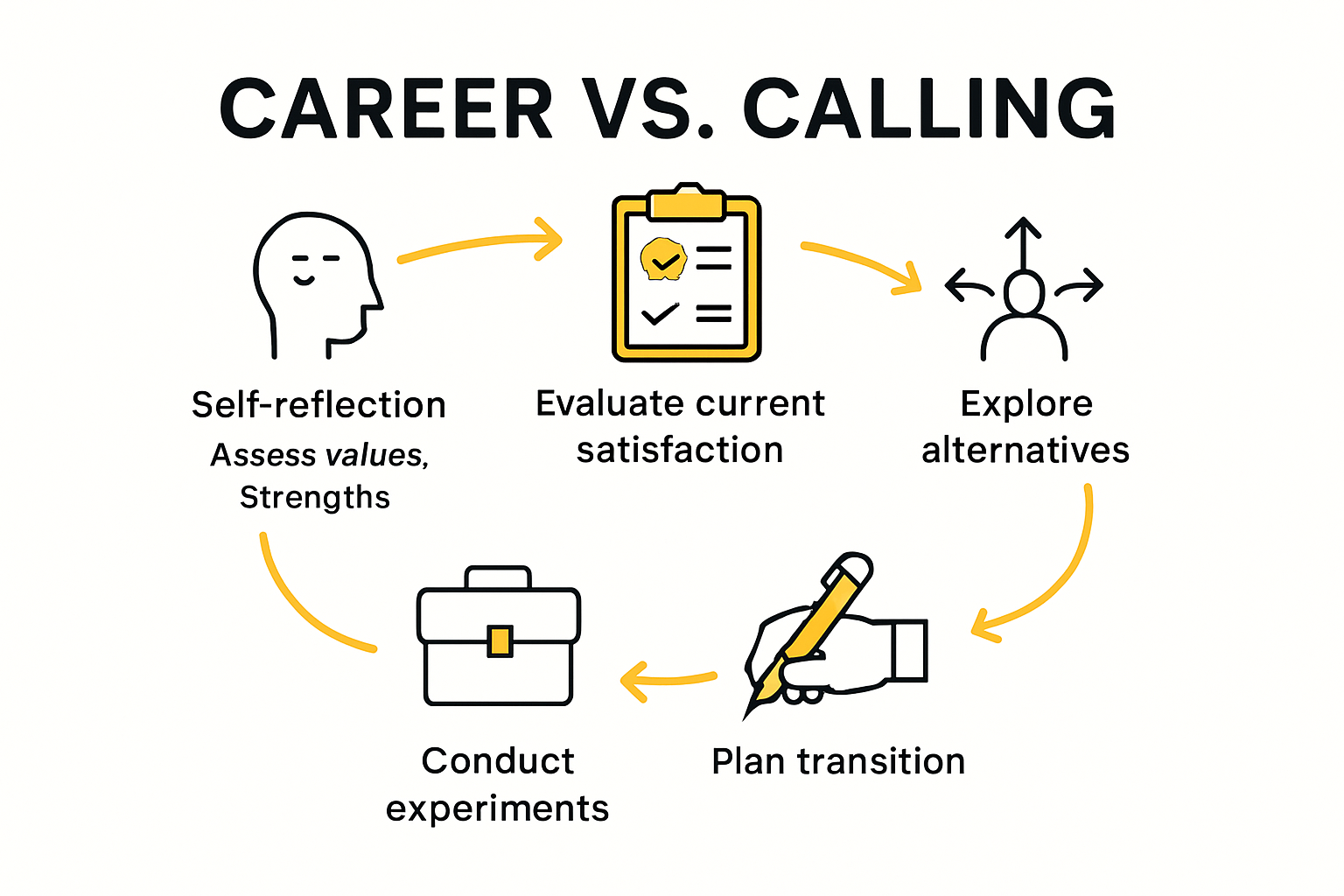
Step 1: Identify Your Core Values and Passions
Discovering your true calling begins with understanding the deep motivations and core values that drive your most authentic self. This foundational step is about peeling back layers of external expectations and societal conditioning to uncover what genuinely lights you up from the inside. Most professionals find themselves stuck in careers that feel mechanically chosen rather than intentionally crafted, missing the profound connection between their inner purpose and outer work.
Starting this journey requires radical self-reflection and honest introspection. Begin by creating dedicated quiet time where you can explore your inner landscape without distractions. Grab a journal and start asking yourself powerful questions: What activities make me lose track of time? When do I feel most alive and energized? What issues or challenges in the world genuinely move me? These questions are not casual inquiries but portals into understanding your deeper motivations.
Practical exploration involves tracking your emotional responses across different experiences. Pay attention to moments when you feel genuinely excited, completely absorbed, or deeply satisfied. These emotional signals are breadcrumbs leading you toward your authentic calling. Consider creating a dedicated journal or digital document where you log these experiences, noting specific details about what made each moment special. You might discover patterns revealing your core passions that have been quietly waiting for recognition.
To support your exploration, discover coaching tools that unlock your inner potential can provide structured guidance. Remember, identifying your core values and passions is not a linear process but an evolving journey of self-discovery. Be patient with yourself, remain curious, and trust that your inner wisdom will gradually reveal the unique path meant specifically for you.
Step 2: Evaluate Your Current Career Path and Satisfaction
Evaluating your current career path requires a brutally honest assessment of your professional landscape, moving beyond surface-level satisfaction to understand the deeper currents driving your work experience. This step is about creating a comprehensive snapshot of your professional reality, revealing the gap between your current trajectory and your authentic calling.
Begin by conducting a holistic career audit that goes far beyond traditional performance metrics. Reflect on your daily emotional experience at work. Do you feel energized or depleted after completing tasks? Track your mood and energy levels throughout the workweek, noting moments of genuine engagement versus times of mental exhaustion. Pay special attention to the activities that make time disappear versus those that feel like endless trudging. These emotional indicators are critical signposts pointing toward your true professional alignment.
Explore personalized career guidance tools can help structure this introspective process. Conduct a systematic evaluation by creating a detailed professional journal documenting your current role’s strengths and limitations. Assess key dimensions: intellectual stimulation, creative expression, financial compensation, personal growth opportunities, workplace culture, and alignment with your core values. Rank each dimension on a scale from 1 to 10, providing a quantitative perspective on your career satisfaction.
To make it easier to compare aspects of your current job with your ideal calling, here is a table summarizing the primary dimensions to assess during your career evaluation process:
| Evaluation Dimension | Description | Self-Reflection Prompt |
|---|---|---|
| Intellectual Stimulation | Level of mental engagement and learning | Am I challenged and intellectually engaged? |
| Creative Expression | Opportunities for creativity and innovation | Can I express my ideas and creativity freely? |
| Financial Compensation | Alignment between pay and personal financial goals | Does my income meet my needs and expectations? |
| Personal Growth | Opportunities for skill development and advancement | Am I growing and evolving in my role? |
| Workplace Culture | Fit and alignment with organizational values | Do I feel comfortable in my work environment? |
| Core Value Alignment | Degree of match between work and personal values | Does work reflect what matters most to me? |
| Emotional Impact | Effect of work on energy, enthusiasm, and well-being | Do I feel energized, satisfied, or drained? |
The most transformative insights emerge when you courageously examine the emotional and psychological toll of your current professional path. Are you experiencing chronic stress, diminished motivation, or a sense of disconnection? These are not mere inconveniences but profound signals indicating misalignment between your inner purpose and external work. Your career evaluation is not about criticism but compassionate self-understanding, recognizing that professional fulfillment is a dynamic journey of continuous realignment and growth.
Step 3: Explore Alternative Opportunities and Interests
Exploring alternative opportunities is a transformative process of professional discovery that requires intentional curiosity and strategic investigation. This step moves beyond passive contemplation into active exploration, creating intentional pathways to understand potential career directions that might align more closely with your authentic calling.
Begin by constructing what career experts call an opportunity exploration matrix. This involves systematically researching and documenting potential career paths that intersect with your core values and passions. Start by reaching out to professionals in fields that intrigue you through informational interviews, LinkedIn connections, or professional networking events. These conversations are not about securing a job but gathering rich, nuanced insights about different professional landscapes. During these interactions, ask profound questions about daily work experiences, unexpected challenges, and what truly motivates them in their respective fields.
Discover coaching strategies for career exploration can provide additional structured guidance for this process. Your exploration should include practical experiments beyond theoretical research. Consider engaging in low-risk professional experiments such as online courses, weekend workshops, volunteer opportunities, or freelance projects that allow you to test potential career directions without making permanent commitments. These micro-experiences provide tangible insights into different professional environments, helping you understand the practical realities of various career paths.
The most critical aspect of this exploration is maintaining an open and curious mindset. Approach each potential opportunity as a learning experience rather than a definitive career choice. Document your insights, emotional responses, and energy levels during these exploratory activities. Pay attention to moments of genuine excitement, intellectual stimulation, and a sense of flow. These subtle emotional signals are powerful indicators guiding you toward your authentic professional calling, revealing paths that resonate deeply with your inner motivations and unique talents.
Step 4: Create an Action Plan for Transitioning
Creating an action plan for transitioning from your current career to your true calling is a strategic process that requires careful planning, intentional skill development, and a structured approach to personal transformation. This step is about transforming your insights and explorations into a concrete roadmap that bridges your current professional reality with your desired future.
Begin by developing a comprehensive transition blueprint that breaks down your ultimate career goal into granular, manageable milestones. This plan should include specific skill acquisition targets, financial preparation strategies, and a realistic timeline for your transition. Consider creating a visual representation of your journey, perhaps using a digital mind mapping tool or a detailed spreadsheet that tracks your progress across different dimensions such as skill development, networking, financial readiness, and emotional preparation.
Unlock personalized transition strategies can provide additional guidance for structuring your plan. Your action plan must address both practical and psychological aspects of career transition. This means developing a financial cushion that provides stability during your shift, identifying the specific skills and certifications required in your new field, and creating a robust professional network that can support your transition. Schedule regular check-in moments with yourself to assess progress, recalibrate goals, and maintain momentum.
The most critical element of your transition plan is building psychological resilience. Recognize that career transformation is not a linear process but a complex journey with potential setbacks and unexpected challenges. Develop a support system that includes mentors, career coaches, and trusted peers who can provide guidance and emotional support. Your action plan should include strategies for managing self-doubt, maintaining motivation, and celebrating incremental victories along the way. Remember, a successful transition is not just about reaching a destination but about embracing the growth and self-discovery inherent in the journey itself.
Step 5: Test Your Calling Through Small Experiments
Testing your potential calling through strategic small experiments is a crucial phase of professional discovery that allows you to validate your insights without making drastic, irreversible changes. This step transforms theoretical exploration into tangible, low-risk experiences that provide real-world validation of your emerging professional direction.
Design micro-commitments that allow you to sample your potential calling with minimal financial or professional risk. These experiments might include weekend workshops, online certification courses, volunteer projects, or freelance gigs that provide direct exposure to your areas of interest. The goal is not immediate mastery but gathering lived experience and emotional data about how these potential paths genuinely feel. Pay close attention to your energy levels, enthusiasm, and sense of engagement during these experiments. Are you feeling alive and curious, or are you experiencing subtle resistance and emotional drain?
Discover intuitive career exploration techniques can provide additional guidance for this critical phase. Create a detailed experimentation journal to document your micro-experiments. Track not just external outcomes but your internal experience—emotional responses, energy fluctuations, moments of flow, and instances of challenge. This journal becomes a powerful reflective tool, helping you distinguish between fleeting interest and genuine calling. Be intentional about creating structured feedback loops, seeking input from mentors, peers, or professionals in the field who can offer nuanced perspectives on your exploratory efforts.
Here is a checklist you can use during the ‘Test Your Calling Through Small Experiments’ phase to track your actions and learning:
| Experimentation Step | Completed (Y/N) | Notes/Insights |
|---|---|---|
| Identified area(s) to experiment with | ||
| Selected a small experiment (e.g., workshop, course) | ||
| Scheduled time for the experiment | ||
| Completed the experiment | ||
| Recorded emotional/energy responses | ||
| Reflected on outcomes in journal | ||
| Sought feedback from mentors/peers | ||
| Decided on next step based on results |
The most transformative aspect of these experiments is developing radical self-trust. Recognize that your calling is not a destination but an evolving journey of alignment. Each experiment is an opportunity to listen more deeply to your inner wisdom, refining your understanding of what truly lights you up. Approach these tests with curiosity rather than pressure, understanding that temporary discomfort or uncertainty is a natural part of meaningful professional growth.
Step 6: Reflect and Commit to Your Chosen Path
Reflecting and committing to your chosen path represents the most profound moment of transformation in your journey from career to calling. This step is not about making a perfect choice, but about courageously embracing your authentic professional direction with intentional awareness and profound self-trust.
Begin by creating a comprehensive reflection ritual that allows you to deeply process your experimental experiences. Set aside dedicated uninterrupted time in a space that feels peaceful and conducive to introspection. Review your experimentation journals, noting patterns of excitement, energy, and genuine engagement across your various micro-experiments. Look beyond surface-level achievements and focus on moments that made you feel truly alive, intellectually stimulated, and emotionally connected to your work. This is not about rational analysis alone, but about listening to the subtle emotional intelligence that has been guiding your journey.
Explore deeper self-discovery techniques can provide additional support during this critical phase. Your commitment process requires developing a holistic alignment framework that evaluates your potential path across multiple dimensions. Consider how this calling intersects with your core values, financial needs, personal growth aspirations, and broader life vision. Create a personal mission statement that articulates not just what you will do, but why you are choosing this path. This statement becomes your north star, providing clarity and motivation during inevitable moments of doubt or challenge.
The most transformative aspect of commitment is cultivating radical acceptance. Recognize that choosing a calling is not about achieving perfection, but about embracing a journey of continuous learning and evolution. Your commitment is not a final destination, but a dynamic process of growth. Be willing to remain flexible, continuously refine your approach, and trust that your inner wisdom will guide you through both challenges and opportunities. Your calling is not something you find, but something you courageously create through persistent, intentional action.
Step Into Your True Calling With Plentiful’s Support
Are you struggling to uncover your authentic purpose or feeling disconnected from your current career path? If questions like “What energizes me?” or “How can I build a life based on my passions?” have you searching for guidance, you are not alone. In Career vs Calling: How to Know What You’re Here to Do, we explored the challenges of identifying core values, evaluating career satisfaction, and creating a real plan for change. Finding the courage to move past uncertainty and take action on your dreams often requires expert support and ongoing inspiration.

Plentiful is here to bridge the gap between career confusion and true fulfillment. Connect with coaches and guides who specialize in career discovery, holistic well-being, and intentional life transitions. Experience 1:1 sessions, group workshops, or digital resources personalized to your journey. Visit Plentiful’s main platform now and discover how tailored support can turn your insights into lasting transformation. Take your first step today and start building a path that is truly meant for you.
Frequently Asked Questions
What steps can I take to identify my core values and passions?
To identify your core values and passions, start with self-reflection and introspection. Create quiet time for yourself to explore questions like what activities make you lose track of time and when you feel most energized. Maintain a journal to log your experiences and emotional responses, which will help unveil patterns leading you toward your authentic calling.
How can I evaluate my current career path and job satisfaction?
You can evaluate your current career path by conducting a holistic career audit. Reflect on your daily emotional experiences, tracking both energizing activities and those that feel depleting. Document your current role’s strengths and limitations, assessing factors like intellectual stimulation and alignment with your core values to gauge your overall job satisfaction.
What are some effective ways to explore alternative career opportunities?
To explore alternative career opportunities, construct an opportunity exploration matrix by researching different paths that align with your core values and passions. Engage in informational interviews, attend networking events, and participate in low-risk professional experiments, like workshops or freelance projects, to gain firsthand experience in potential careers.
How do I create an actionable plan for transitioning to a new career?
Creating an actionable plan involves developing a transition blueprint that breaks your goal into manageable milestones. Include specific skill acquisition targets, financial preparation strategies, and a timeline. Address both practical and psychological aspects of the transition, and build a support network to maintain motivation throughout the process.
Recommended
- How To Find Your Dream Career: Key Considerations – Plentiful
- The Benefits Of Using a Job Coach – Try Career Coaching
- Trapped in the Wrong Career? Redesign Your Work Life | Career
- What does your life path number really mean? A super simple guide – Plentiful
- Discover What Life Is Calling You To Do | Anita Rolls
- Unleash Your Potential – 5 Top Strengths | Heather Kunz
- Inject More Joy Into Your Job | Casie Tennin
- SOS: 60 Minutes To Clarity | Casie Tennin
Ready to improve your life?
Access our free newsletter designed to help you become the best version of yourself.
Learn how to find your path, understand yourself, and make progress toward your dream life.