
Last Tuesday, a friend called me in a panic: “Can you help me with this project? I’m drowning.” My calendar was already packed, my to-do list was groaning, but without thinking I said, “Sure.”
By Friday night, I was exhausted, behind on my own work, and (if I’m honest) a little resentful. Sound familiar?
Most of us are raised to believe that saying “yes” is the golden ticket. Yes to every request, every favor, every last-minute meeting invite. The logic is simple: the more you give, the more you’ll get. But here’s the truth that often catches people off guard: constantly saying yes doesn’t lead to deeper relationships or faster growth. It leads to burnout, resentment, and a slow erosion of your own priorities.
Research from the Mayo Clinic shows that setting healthy, firm boundaries doesn’t push people away — it actually lowers stress, boosts life satisfaction, and strengthens connections. Boundaries aren’t about building walls; they’re about creating space. Space for clarity. Space for energy. Space for the right people and opportunities to flow in.
When you learn to protect your time, your emotional bandwidth, and your values, you stop living on everyone else’s terms and start leading a life that’s truly your own. That’s not selfish… it’s the foundation for fulfillment and sustainable growth.
Table of Contents
- Why Boundaries Matter For Lasting Success
- Recognizing Where You Need Better Boundaries
- Simple Steps To Set And Communicate Boundaries
- Managing Pushback And Staying Consistent
Quick Summary
| Takeaway | Explanation |
|---|---|
| Setting boundaries enhances well-being | Healthy boundaries protect your emotional health and help manage stress effectively. |
| Recognize signs of boundary erosion | Be aware of feelings like fatigue and resentment, indicating boundaries may be lacking. |
| Communicate boundaries clearly and compassionately | Use ‘I’ statements to express your limits without blaming others, fostering mutual respect. |
| Implement and maintain boundaries consistently | Continuously uphold your boundaries to reinforce self-respect and demonstrate personal integrity. |
| Embrace resistance as part of the process | Understand that pushback is typical; stay focused on your needs without feeling guilty. |
Why Boundaries Matter for Lasting Success
Personal and professional success isn’t just about hard work or talent. It’s fundamentally about understanding and implementing strategic boundaries that protect your energy, time, and emotional well-being. Boundaries are not walls that isolate you, but intentional frameworks that create space for meaningful growth and authentic interactions.
The Psychological Foundation of Healthy Boundaries
At its core, setting boundaries is an act of self-respect and personal empowerment. Learn more about professional growth strategies that emphasize the critical role of personal limits. According to the University of Illinois Extension, creating healthy boundaries is crucial for physical, mental, and emotional health. These personal guidelines help individuals identify safe and respectful behaviors, effectively communicating personal needs while establishing clear limits in relationships.
Research from the Mayo Clinic Health System reveals that developing strong boundaries directly contributes to reducing stress and increasing overall life satisfaction. By preventing the emotional burden of taking responsibility for others’ feelings and behaviors, individuals can maintain a healthier psychological landscape.
Professional Impact of Strategic Boundaries
In the professional realm, boundaries are not just recommended they are essential. Vanderbilt University’s research highlights that clear workplace boundaries help reduce stress, increase productivity, and foster profound respect and professionalism. Successful professionals understand that boundaries are not about creating distance but about establishing mutual understanding and respect.
These strategic limits protect your time, energy, and professional integrity. They allow you to focus on high-value work, prevent burnout, and maintain a clear distinction between personal and professional responsibilities. By communicating your limits clearly and consistently, you demonstrate self-awareness and professionalism that commands respect from colleagues and leadership.
Personal Growth Through Boundary Setting
Boundary setting is a dynamic skill that evolves with self-awareness and personal development. It requires continuous reflection, courage, and a commitment to your own well-being. When you establish and maintain healthy boundaries, you create an environment that supports your growth, protects your mental health, and enables you to show up authentically in all areas of life.
The most successful individuals are not those who say yes to everything, but those who strategically choose where to invest their time and energy. Boundaries transform from restrictive concepts to powerful tools of personal agency, allowing you to design a life aligned with your values, goals, and deepest aspirations.
Recognizing Where You Need Better Boundaries
Recognizing the need for better boundaries is a transformative process of self-awareness and personal growth. Many professionals struggle to identify when their personal and professional limits are being consistently overstepped, leading to chronic stress, diminished performance, and emotional exhaustion.
Physical and Emotional Warning Signs
Learn how to trust your inner guidance when evaluating your boundary health. According to research from the National Center for Biotechnology Information, key indicators that you need stronger boundaries include persistent feelings of resentment, chronic fatigue, and a sense of being constantly overwhelmed. These emotional and physical signals are your body’s way of communicating that your current boundaries are ineffective.
Physical symptoms might manifest as frequent headaches, disrupted sleep patterns, unexplained muscle tension, or a persistent sense of anxiety. Emotionally, you might notice increased irritability, difficulty concentrating, feeling emotionally drained after interactions, or experiencing a significant drop in motivation and creativity.
Here’s a summary table highlighting common physical and emotional warning signs that indicate a need for better boundaries. This can help you quickly assess your own experiences and recognize where boundary improvements may be needed.
| Warning Sign Type | Common Signs |
|---|---|
| Physical Symptoms | Frequent headaches, disrupted sleep, muscle tension |
| Persistent sense of anxiety | |
| Emotional Symptoms | Increased irritability, difficulty concentrating |
| Feeling emotionally drained after interactions | |
| Significant drop in motivation and creativity |
Professional Boundary Erosion
In professional settings, boundary erosion often occurs subtly. You might find yourself consistently working beyond scheduled hours, responding to work communications during personal time, or taking on responsibilities that fall outside your job description. These behaviors indicate a lack of clear professional boundaries and can lead to burnout and decreased job satisfaction.
Additionally, if you frequently feel uncomfortable saying no to requests, find yourself apologizing for setting basic limits, or experience guilt when prioritizing your own needs, these are clear signs that your boundary-setting skills need refinement. Professionals who consistently prioritize others’ demands over their own well-being are at high risk of experiencing professional stagnation and personal dissatisfaction.
Personal Relationship Boundary Challenges
In personal relationships, boundary issues often manifest through patterns of people-pleasing, feeling responsible for others’ emotions, or tolerating disrespectful behavior. You might notice that you struggle to communicate your needs effectively, feel consistently drained after social interactions, or find yourself compromising your values to maintain harmony.
Recognizing these patterns requires honest self-reflection and a willingness to acknowledge where your current approach to relationships is not serving your well-being. The first step in establishing healthier boundaries is developing the awareness that your current boundaries are insufficient. By paying attention to these physical, emotional, and interpersonal signals, you can begin the important work of redesigning your personal and professional boundaries to support your growth and fulfillment.
Simple Steps to Set and Communicate Boundaries
Setting and communicating boundaries is a skill that requires practice, self-awareness, and intentional communication. While the process might feel uncomfortable initially, it becomes more natural with consistent application and a clear understanding of your personal needs and values.
Self-Assessment and Clarity
Discover strategies for personal empowerment as you begin your boundary-setting journey. The first step involves deep self-reflection to understand your personal limits, values, and non-negotiables. Start by identifying specific situations where you feel overwhelmed, disrespected, or emotionally drained. Ask yourself critical questions: What interactions consistently leave me feeling depleted? Where am I compromising my well-being to please others?
Journaling can be an effective tool for this self-assessment. Write down specific scenarios where you feel your boundaries have been crossed, and articulate precisely what made you uncomfortable. This process helps transform vague feelings of unease into concrete, actionable insights about your personal boundaries.
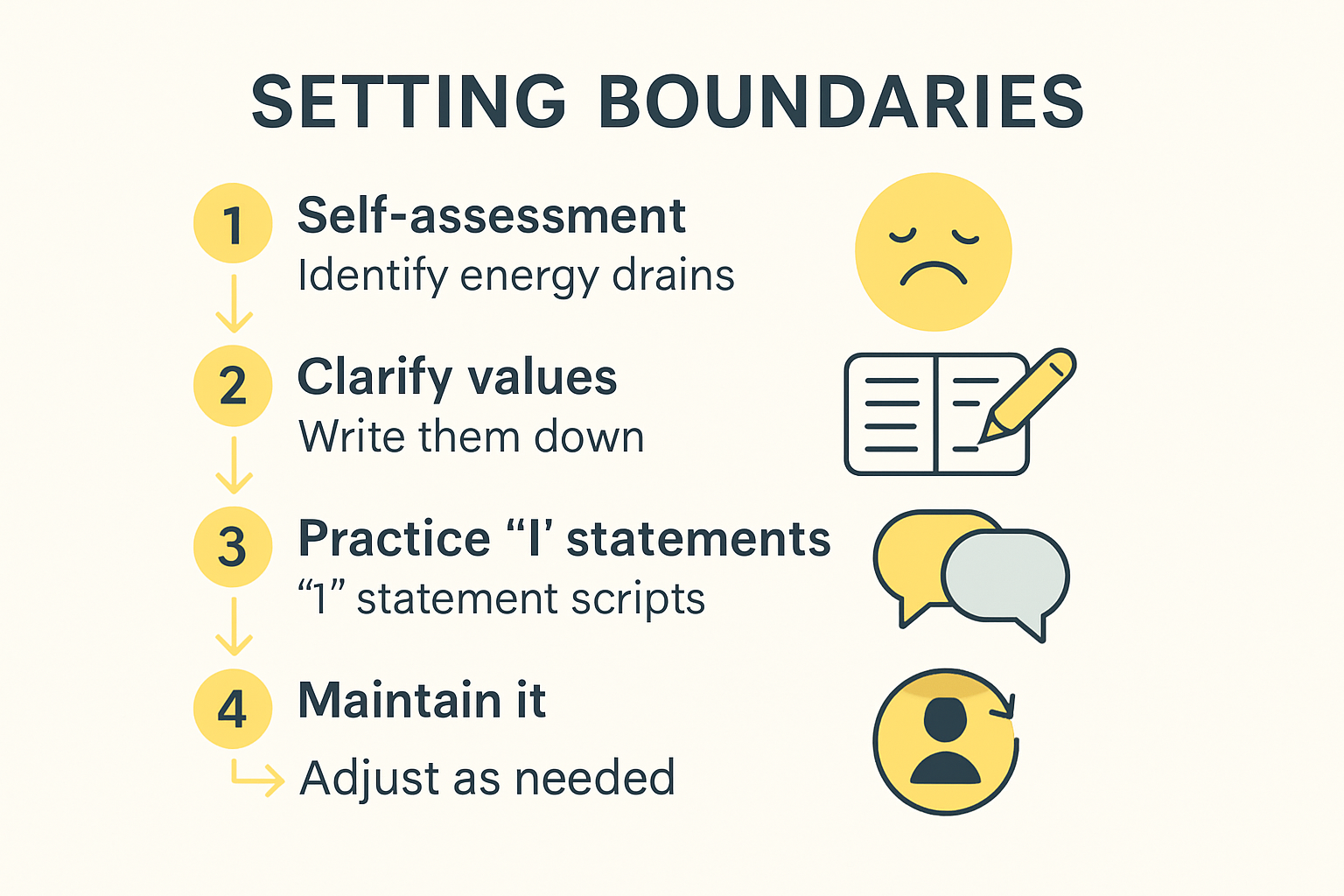
This process table breaks down the essential steps for setting and communicating healthy boundaries, offering a clear road map to follow as you put this essential skill into practice.
| Step | Description |
|---|---|
| Self-Assessment and Clarity | Reflect on and identify your personal limits, values, and situations needing boundaries |
| Journaling for Insight | Write down situations where boundaries were crossed to clarify needs |
| Craft Clear Communication | Use “I” statements to express boundaries without blaming |
| Make Specific Requests | Clearly state your expectations or needed changes in behavior |
| Consistent Application and Review | Regularly reinforce boundaries and adjust as needed |
Crafting Clear and Compassionate Communication
Once you’ve identified your boundaries, the next crucial step is communicating them effectively. According to communication experts, the most successful boundary-setting follows a three-part framework: state the observation, express your feeling, and make a clear request. For instance, instead of saying “You always interrupt me,” try “I’ve noticed that during our conversations, I’m frequently interrupted. I feel frustrated and unheard when this happens. Moving forward, I would appreciate if we could take turns speaking.”
The key is to use “I” statements that focus on your experience without blaming or attacking the other person. This approach reduces defensiveness and opens the door to mutual understanding. Remember that setting boundaries is not about controlling others but about clearly defining your personal space and expectations.
Implementing and Maintaining Boundaries
Establishing boundaries is an ongoing process that requires consistent practice and gentle reinforcement. Be prepared for potential resistance, especially from individuals accustomed to your previous, more accommodating behavior. When someone challenges your newly established boundary, respond with calm consistency. Restate your boundary clearly and avoid getting drawn into lengthy debates or justifications.
It’s also essential to recognize that boundary-setting is a skill that improves with practice. You might not get it perfect every time, and that’s okay. Be patient with yourself, celebrate small victories, and view each interaction as an opportunity to refine your communication skills. Some boundaries might need adjustment as you grow and your circumstances change, so remain flexible while staying true to your core values.
By approaching boundary-setting as a compassionate act of self-care rather than a confrontational strategy, you create space for more authentic, respectful relationships. These boundaries become protective frameworks that allow you to show up more fully in your personal and professional life, preserving your energy and maintaining your sense of personal integrity.
Managing Pushback and Staying Consistent
Setting boundaries is challenging, but maintaining them consistently is even more demanding. When you begin establishing clear personal and professional limits, you will inevitably encounter resistance from those accustomed to your previous more accommodating behavior.
Understanding Resistance Patterns
Explore personal growth strategies to help you navigate boundary challenges. According to Harvard Pilgrim Health Care, establishing effective boundaries requires designing both soft and hard limits, continuously communicating your needs, and prioritizing your mental and physical well-being.
Resistance often emerges through various tactics: guilt-tripping, minimizing your feelings, passive-aggressive responses, or direct confrontation. These reactions are typically defense mechanisms from individuals who benefit from your previous lack of boundaries. Recognize that their discomfort is not your responsibility. Your boundary-setting is about self-preservation, not about managing others’ emotional responses.
Strategies for Consistent Boundary Maintenance
Vanderbilt University’s research emphasizes the critical importance of prioritizing oneself and maintaining clear work boundaries. When facing pushback, employ consistent, calm, and neutral communication techniques. Use phrases that are direct yet respectful: “I understand your perspective, and my boundary remains the same” or “I appreciate your input, and I’m choosing to maintain this limit.”
Consider implementing a structured approach to boundary maintenance. Coursera’s guidance recommends starting with small, manageable boundaries and gradually expanding them. Begin by saying ‘yes’ only when you genuinely mean it, avoiding unnecessary explanations or apologies. Practice leaving work responsibilities at work and be prepared to reassert your boundaries when they are initially crossed.
Emotional Resilience and Self-Compassion
Maintaining boundaries requires emotional resilience. Understand that initial discomfort is normal and does not indicate failure. Some relationships might change or even dissolve as you establish healthier interaction patterns. This is not a personal shortcoming but a natural consequence of the online empowerment program.
Develop a support system that understands and respects your boundary-setting journey. This might include trusted friends, mentors, or professional coaches who can provide guidance and validation. Regularly practice self-compassion, acknowledging that boundary-setting is a skill that improves with time and experience.
Remember that consistency is more important than perfection. You will occasionally slip or face challenging situations. When this happens, quickly realign with your established boundaries. Each time you maintain a limit, you’re reinforcing your self-worth and teaching others how to treat you with respect. Your boundaries are a profound act of self-love and a powerful tool for personal and professional transformation.
Frequently Asked Questions
Why are boundaries important for personal growth?
Setting boundaries enhances well-being by protecting your emotional health, reducing stress, and promoting authentic relationships, which all contribute to personal growth.
How can I recognize if I need better boundaries in my life?
You may need better boundaries if you experience physical signs like fatigue and headaches, or emotional signs like irritability and feeling overwhelmed. Keep an eye out for consistent feelings of resentment or difficulty concentrating.
What are some effective ways to communicate my boundaries?
Use ‘I’ statements to express your feelings and state your needs clearly. For example, say, “I feel overwhelmed when I’m interrupted during conversations; I would appreciate if we could take turns talking.”
How can I manage pushback when establishing my boundaries?
Expect some resistance as you implement your boundaries. Respond with calm consistency, reiterate your limits respectfully, and remember that setting boundaries is a form of self-preservation, not a confrontation.
Ready to Set Boundaries and Take Control of Your Growth?
If you found yourself nodding along while reading about the challenges of saying no, feeling emotionally drained, or struggling to communicate your limits, you’re not alone. Many people face the same roadblocks when trying to protect their time and energy. At Plentiful, you do not have to navigate this journey on your own. Access a community of experienced coaches and holistic practitioners who understand the powerful impact of boundaries on well-being and fulfillment.

Start experiencing the benefits of clear boundaries today. Book a session with a professional coach or join a live workshop to build confidence and skills for lasting change. Explore our platform for personalized coaching and support that aligns with your growth goals. Take the first step now at Plentiful and discover services designed to help you thrive, not just survive.
Recommended
- Foundations for Fulfillment by Hanna Carroll
- Resilient Leader: Coaching for Professional Women
- Communicate with Impact & Influence | Becca Darr
- Return to Ease | Lexy Davis
- Empower Your Feminine Essence | Jonita D’Souza
- How to stand up for yourself even when it’s tough (practical guide)
- Empath Signs & Traits: Understanding Empathic Experiences
Ready to improve your life?
Access our free newsletter designed to help you become the best version of yourself.
Learn how to find your path, understand yourself, and make progress toward your dream life.