If you’ve ever explored yoga, meditation or energy healing, you’ve probably encountered the idea of chakras. You may also have heard people describe a chakra as blocked, depleted or out of balance.
So how do you actually cleanse or balance your chakras?
Chakra cleansing is a spiritual and wellness practice intended to bring awareness and balance to the energy centers known as chakras. Common approaches include meditation, breathwork, yoga, sound and other practices that encourage you to slow down and pay attention to what you’re experiencing physically and emotionally.
Chakras come from Indian spiritual and yogic traditions rather than modern anatomy. Chakra cleansing doesn’t literally remove a physical blockage from your body.
You can still find the practice useful. Chakra cleansing can provide a framework for meditation, self-reflection and connecting more deliberately with your body.
What are chakras?
The Sanskrit word chakra means wheel or circle. In Hindu and yogic traditions, chakras are described as centers within the subtle or nonphysical body and are associated with the movement of prana, or vital energy. The Encyclopedia of Psychology and Religion traces the concept to Indian spiritual traditions and the development of subtle-body practices.
Today, you’re most likely to encounter a system of seven main chakras running from the base of the spine to the crown of the head.
That wasn’t always the only chakra system. Different Indian traditions described different numbers, locations and meanings of chakras. Historical scholarship traces systems with six, seven and other configurations across tantric and yogic traditions.
The familiar seven-chakra model used in contemporary yoga and wellness is therefore best understood as one influential interpretation of a much larger tradition.
What are the seven chakras?
The modern seven-chakra system generally looks like this:
| Chakra | Location traditionally associated with it | Common contemporary association |
|---|---|---|
| Root (Muladhara) | Base of the spine | Security and grounding |
| Sacral (Svadhisthana) | Lower abdomen | Creativity and sexuality |
| Solar Plexus (Manipura) | Upper abdomen | Confidence and personal power |
| Heart (Anahata) | Center of the chest | Love and compassion |
| Throat (Vishuddha) | Throat | Communication and expression |
| Third Eye (Ajna) | Between the eyebrows | Intuition and insight |
| Crown (Sahasrara) | Top of the head | Spiritual connection |
Contemporary chakra practitioners widely use these associations. They shouldn’t be interpreted as established biological functions of those locations in the body.
Even the rainbow colors now routinely assigned to the seven chakras are largely a feature of the modern Western chakra system rather than a single ancient scheme handed down unchanged over thousands of years. Contemporary chakra practice has evolved considerably as Indian traditions have interacted with Western yoga, psychology and spirituality.
What does chakra cleansing mean?
Chakra cleansing usually refers to practices intended to clear, balance or restore the flow of energy through the chakras.
Within an energy-based framework, someone might describe a chakra as blocked when an area of life feels constricted or out of balance.
A person struggling to speak up might associate that experience with the throat chakra. Feeling insecure or unsettled might be interpreted through the root chakra. Difficulty opening up emotionally could be explored through the heart chakra.
These can be useful metaphors for reflection.
They aren’t diagnoses.
There isn’t a medical test that can tell you whether your throat chakra is blocked, nor has modern science established chakras as measurable anatomical structures.
That distinction allows you to explore the practice without asking it to do something it wasn’t designed to do.
How do you know if your chakras need cleansing?
There’s no objective test for a blocked chakra.
Within contemporary chakra practice, people may turn to chakra cleansing when they feel emotionally stuck, disconnected from themselves or unusually unsettled. Others incorporate it into an existing yoga, meditation or spiritual practice without waiting for something to feel wrong.
You may also encounter long lists online linking specific physical symptoms to particular chakras.
Treat those carefully.
A headache isn’t evidence of a blocked crown chakra, and digestive problems don’t establish an imbalance in the solar plexus chakra. Physical or psychological symptoms that concern you deserve appropriate professional care.
Chakra work can sit alongside that care as a personal or spiritual practice.
How to cleanse your chakras
There isn’t one accepted method for cleansing chakras. Different traditions and contemporary practitioners use different approaches.
You also don’t have to work through all seven chakras every time. You might focus on one area that feels particularly relevant or simply move your attention gradually through the body.
Here are some of the most common approaches.
1. Chakra meditation
Meditation is probably the simplest place to begin.
Find a comfortable position and bring your attention to your breathing. Once you feel settled, move your awareness gradually from the base of your spine toward the top of your head.
At each chakra, pause and notice what comes up.
You might visualize the color commonly associated with that chakra, repeat a mantra or simply observe sensations and thoughts without trying to change them.
If you’re focusing on a particular chakra, you can also use its contemporary meaning as a prompt.
For the heart chakra, for example, you might reflect on where you feel open or guarded in your relationships. For the throat chakra, you could notice whether there’s something you’ve been reluctant to say.
The purpose doesn’t have to be to make yourself feel something dramatic. Paying attention is enough.
2. Breathwork
Breath is deeply connected with many yogic traditions, particularly through pranayama, the practice of regulating the breath.
For a simple chakra-focused practice, sit comfortably and breathe slowly while directing your attention toward the chakra you’re exploring. Notice the movement of your breath and the sensations in that part of your body.
Some practitioners combine breathing with visualization, imagining the breath moving through or around a particular chakra.
Be cautious with more intensive breathwork techniques, particularly long breath holds or rapid breathing. These practices can produce significant physiological effects and are better learned from someone properly trained.
3. Yoga
Yoga provides another natural way to explore chakra work because the chakra system developed within the broader world of Indian yogic and tantric traditions.
Contemporary teachers often associate particular poses with individual chakras. Grounding standing poses might be used when focusing on the root chakra, while chest-opening poses may accompany heart-chakra work.
There’s good evidence that yoga itself can benefit various aspects of physical and psychological health. That doesn’t demonstrate that those benefits occur because yoga has opened or balanced a chakra.
If chakra language helps you bring greater intention to the practice, it can still serve a purpose.
4. Sound and chanting
Sound has a long relationship with Indian spiritual practice, and mantras are often incorporated into chakra meditation.
In contemporary chakra practice, particular seed syllables or bija mantras may be associated with different chakras. A practitioner might chant the sound while concentrating on the corresponding area of the body.
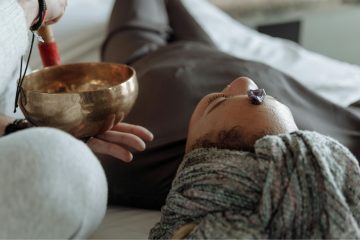
Sound bowls, tuning forks and recorded frequencies are also frequently incorporated into modern chakra work.
A small 2023 randomized crossover pilot study investigated a sound-based form of Nada Yoga meditation and reported changes in measures the researchers associated with chakra energy. The study included only 15 participants and relied on electro-photonic imaging, so it should be considered exploratory rather than evidence that chakras have been scientifically measured.
If sound helps you settle into meditation or become more aware of your body, you don’t need a stronger scientific claim to use it.
You can also explore our guide to healing tones and frequencies if you’re interested in how sound is used in contemporary wellness practices.
5. Visualization
Visualization can make an abstract concept such as chakra balancing easier to work with.
One common practice is to imagine each chakra as a point of light. Starting at the root, picture each area becoming clearer or brighter as you move upward through the body.
You might use the familiar rainbow sequence:
Red → orange → yellow → green → blue → indigo → violet
There’s no requirement to see these colors vividly. If visualization doesn’t come naturally to you, simply directing your attention to each area works just as well as a contemplative exercise.
6. Reiki and energy healing
Contemporary wellness practitioners often combine Reiki and other forms of energy work with chakra cleansing.
A practitioner may place their hands on or above different areas of the body while focusing on the corresponding chakras. People sometimes report relaxation, warmth, tingling or emotional responses during these sessions.
Experiencing those sensations doesn’t prove that an energy blockage has physically cleared.
If you’re curious about experiencing this kind of practice with someone else, Plentiful has energy healing practitioners and experiences.
7. Crystals
Crystals are another popular addition to contemporary chakra practice.
Contemporary practitioners commonly pair stones with chakras according to color. For example, they may use rose quartz for the heart chakra and amethyst for the crown or third-eye chakra.
There isn’t scientific evidence that crystals emit a healing energy that cleanses chakras.
That doesn’t prevent someone from using a crystal as a physical focus for meditation or intention. Holding an object that reminds you what you want to reflect on can be meaningful without requiring a medical explanation.
Can food cleanse your chakras?
You’ll sometimes encounter recommendations to “eat for your chakras,” often by matching foods to chakra colors.
In contemporary chakra practice, people may associate red foods such as tomatoes and berries with the root chakra, and green vegetables with the heart chakra.
There’s no scientific basis for claiming that eating a green vegetable cleanses your heart chakra or that a particular food directly changes chakra energy.
Eating a varied and nutritious diet is worthwhile for plenty of other reasons.
If you enjoy using colors or foods symbolically as part of a broader spiritual practice, that’s different from treating them as chakra medicine.
What about essential oils?
Some practitioners pair essential oils with particular chakras, using scent as part of their meditation or relaxation practice.
Again, the useful distinction is between the experience and the explanation.
You might find a particular scent relaxing or associate it with a particular intention. That doesn’t establish that the oil has altered the flow of energy through a chakra.
If you’re applying essential oils to the skin, follow appropriate dilution and safety guidance. Some oils can cause irritation or other adverse reactions.
What does science say about chakra cleansing?
Science has studied meditation, yoga, breath regulation and other practices frequently incorporated into chakra work.
That gives us evidence about those practices.
It doesn’t give us strong evidence that chakras themselves exist as measurable energy centers or that a particular intervention physically “unblocks” one.
One challenge is that chakra systems describe a subtle body, which isn’t the same thing as the anatomical body studied by modern medicine. Academic reference works explicitly describe chakras within this nonphysical or psychoenergetic framework.
There have been attempts to measure chakra-related phenomena scientifically, including the small Nada Yoga study mentioned earlier. But this is nowhere near the body of replicated evidence we would need to say that science has confirmed chakras.
There is much stronger research on practices that sometimes accompany chakra work. For example, a 2026 systematic review of randomized controlled trials of Kundalini Yoga found promising results across several psychological and physical outcomes, while calling for larger and more standardized studies. Kundalini Yoga incorporates breathwork, movement, meditation and chanting, so the research cannot tell us that chakra balancing itself produced those outcomes.
That distinction is useful.
You can practice chakra meditation because it helps you reflect, focus or feel more connected with your body. You don’t need to turn that experience into a scientific claim.
Chakras and chi aren’t the same thing
Chakras and chi frequently appear together in contemporary wellness culture, but they come from different traditions.
The chakra system developed within Indian spiritual and yogic traditions. Chi, or qi, comes from Chinese philosophy and traditional Chinese medicine.
Because both concepts are often described using the language of energy, they can sound similar. Historically, they belong to different traditions and describe energy in different ways.
If you’d like to understand chi in more depth, read our guide to what chi is and how the concept was developed.
For a direct comparison, see our guide to chakra vs. chi.
How often should you cleanse your chakras?
There’s no prescribed schedule.
Some people incorporate chakra meditation into a regular yoga or meditation practice. Others return to it occasionally when they want to reflect on a particular part of their life.
Frequency matters less than whether the practice is useful to you.
If a ten-minute meditation once a week helps you notice how you’re feeling, that may be plenty. If you’re drawn to a more sustained practice, you could spend several days exploring each chakra in turn.
Avoid making chakra cleansing another standard you have to meet.
What should chakra cleansing feel like?
There isn’t one correct sensation.
The experience varies. You might feel relaxed or emotional, notice warmth or tingling as you focus on a particular area of your body, or feel very little at all.
None of those responses determines whether you’ve done the practice correctly.
Be especially wary of anyone telling you that discomfort proves toxins or blocked energy are leaving your body. Physical symptoms deserve to be understood on their own terms rather than automatically interpreted as evidence that a spiritual practice is working.
A grounded approach to chakra cleansing
Chakra cleansing can be approached as a way of paying attention.
The chakra system offers a framework for exploring different parts of your experience, from security and confidence to relationships, self-expression and spirituality.
You can sit with one of those themes during meditation, explore it through movement or work with a practitioner who uses the chakra system as part of their approach.
You don’t have to prove that an invisible wheel of energy has physically changed for the practice to mean something.
If chakra work helps you notice something you’ve been ignoring, reconnect with your body or make space for reflection, that may be reason enough to keep exploring it.
If you’d like some guidance, you can explore energy healing and chakra-focused experiences on Plentiful.
Frequently asked questions
What is chakra cleansing?
Chakra cleansing is a spiritual or wellness practice intended to restore balance to the energy centers known as chakras. Common approaches include meditation, yoga, breathwork, visualization, sound and energy healing.
How do you cleanse your chakras?
Meditation is one of the simplest approaches. Bring your attention gradually through the seven chakras, noticing physical sensations, emotions and thoughts associated with each area. Some people incorporate breathing, visualization, yoga, chanting or sound into the practice.
How do I know if my chakras are blocked?
There is no objective medical test for a blocked chakra. Within chakra traditions, people may interpret emotional difficulties or feelings of disconnection through the chakra system. Physical or psychological symptoms shouldn’t automatically be attributed to chakra blockages.
Can you cleanse all seven chakras at once?
Yes. Many chakra meditations move progressively from the root chakra at the base of the spine through each chakra to the crown. You can also focus on one chakra if a particular theme feels more relevant.
How long does chakra cleansing take?
There’s no required length. A simple meditation might take 10 or 15 minutes, while a yoga, sound-healing or energy-work session could last considerably longer.
Does chakra cleansing actually work?
That depends on what you expect it to do. Practices used in chakra work, including meditation and yoga, have been studied for various wellbeing outcomes. Science hasn’t established that chakra cleansing removes measurable energy blockages from the body.
Can chakra cleansing make you feel emotional?
Meditation and reflective practices can sometimes bring emotions to the surface, particularly when you’re deliberately focusing on difficult experiences or relationships. That doesn’t necessarily mean a chakra has become “unblocked.”
Are chakra cleansing and Reiki the same thing?
No. Reiki is a Japanese energy-healing practice, while chakras originated in Indian spiritual traditions. Some contemporary Reiki practitioners incorporate chakras into their work, which is why the two are often encountered together.