
When comparing chakra vs. chi, it’s easy to assume they’re different names for essentially the same thing. They aren’t.
The main difference is that chakras are centers described within Indian spiritual and yogic traditions, while chi, or qi, is a Chinese concept of vital force found in Chinese philosophy and traditional Chinese medicine.
Modern wellness practices sometimes combine the two systems. Historically, however, they developed separately and shouldn’t be treated as interchangeable.
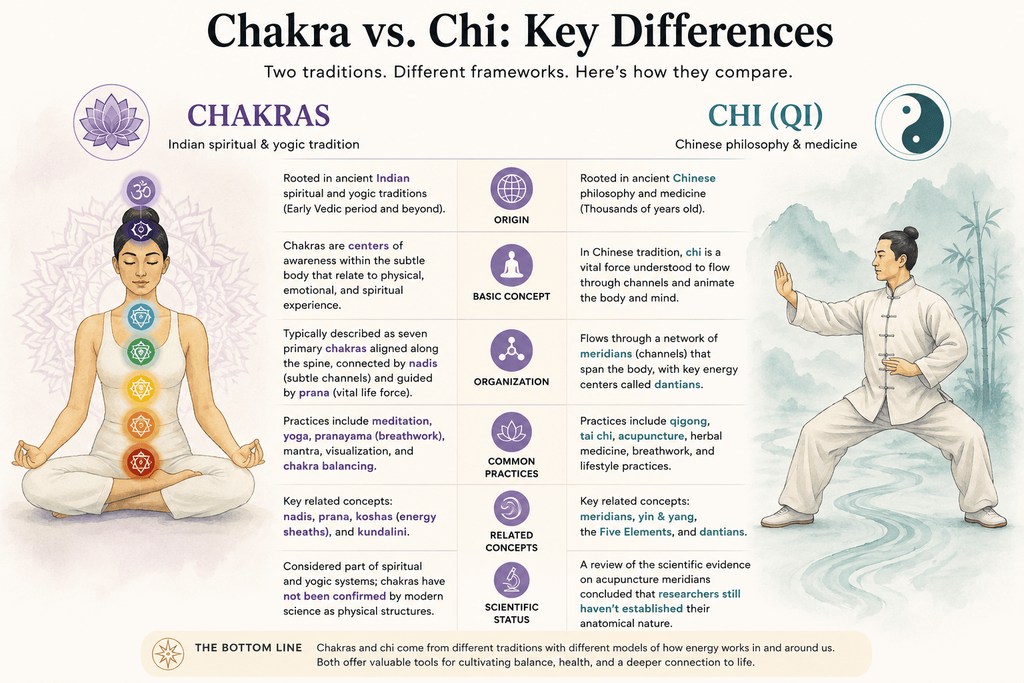
Chakra vs. chi at a glance
| Chakras | Chi / Qi | |
|---|---|---|
| Origin | Indian spiritual and yogic traditions | Chinese philosophy and traditional Chinese medicine |
| Basic concept | Centers within the subtle body | Vital energy or life force |
| How it is organized | Various chakra systems exist; the modern seven-chakra model is the best known in the West | Qi is traditionally understood to circulate through channels often called meridians |
| Common modern practices | Meditation, yoga, breathwork, visualization | Qigong, tai chi, acupuncture and other traditional Chinese practices |
| Related concepts | Nadis, kundalini, prana | Meridians, dantians, yin and yang |
| Scientific status | Chakras haven’t been established as anatomical structures | Qi and meridians remain traditional concepts rather than established anatomical structures |
So while both traditions use concepts that English speakers frequently translate using words such as energy or life force, they describe that energy through different frameworks.
What are chakras?
The word chakra comes from Sanskrit and means “wheel” or “disc.” Different Indian religious and yogic traditions developed different chakra systems, so there isn’t one historically universal map of the chakras.
That’s an important point.
The familiar Western model of seven chakras running from the base of the spine to the crown of the head represents one influential interpretation rather than the entirety of the chakra tradition. Scholarly accounts describe multiple historical chakra systems with different numbers, locations and meanings.
In contemporary practice, people often associate the seven chakras with different aspects of human experience:
- Root: security and grounding
- Sacral: creativity and sexuality
- Solar plexus: confidence and personal agency
- Heart: love and compassion
- Throat: communication and expression
- Third eye: intuition and insight
- Crown: spirituality and connection
Practitioners may use meditation, yoga, breathwork, visualization and other techniques to focus attention on these areas.
That doesn’t mean chakras correspond to seven physical organs, glands or structures in the human body. They belong to a spiritual model of the subtle body rather than modern anatomy.
If you’d like to explore the practice itself, our guide to chakra cleansing and balancing explains the seven-chakra system and common ways people work with it.
What is chi?
Chi, more commonly transliterated as qi, is a concept with deep roots in Chinese philosophy and medicine.
Trying to translate qi simply as “energy” can be misleading because the concept has carried different meanings across Chinese philosophical, medical and spiritual traditions.
Early Chinese philosophical texts discuss qi in relation to the body, nature, health and life itself. The Stanford Encyclopedia of Philosophy, for example, describes the important role that ideas about qi played alongside yin and yang in early Chinese thought.
Within traditional Chinese medicine, practitioners understand qi as circulating through a network of channels commonly called meridians. The U.S. National Library of Medicine describes meridians as classical acupuncture pathways through which qi traditionally circulates and along which acupuncture points occur.
That framework underpins or influences practices including:
- acupuncture
- qigong
- tai chi
- some forms of Chinese massage
- other aspects of traditional Chinese medicine
If you want to go deeper, our guide to what chi is and how the concept developed explores qi in much more detail.
Are chakras and chi the same thing?
No. Chakras and chi come from different traditions and describe different concepts.
This is where contemporary wellness language can create confusion.
People frequently describe both systems using the word energy. As a result, you may encounter explanations claiming that chi flows through the chakras or that chakras are simply another culture’s version of Chinese energy centers.
Historically, that isn’t an accurate way to describe either tradition.
Chakra systems developed within Indian traditions. Qi developed within Chinese philosophy and medicine. Each belongs to a larger conceptual system with its own terminology, practices and history.
You can certainly choose to explore both. Many contemporary practitioners do. But combining two traditions is different from claiming they were originally parts of the same system.
Is chi the same as prana?
The chakra vs. chi comparison becomes clearer when you consider prana, although chi and prana still aren’t identical concepts.
Prana comes from Indian traditions and, like qi, often gets translated into English as breath, vital energy or life force. Chakra traditions frequently discuss prana in connection with nadis, the subtle channels through which prana is traditionally understood to move.
That creates a useful distinction:
Chakras are centers within certain Indian subtle-body systems. Prana is the vital force associated with those systems.
Qi plays a somewhat comparable role within Chinese thought, but that doesn’t make qi and prana historically identical.
Even the National Library of Medicine’s definition of qi notes a rough correspondence with Indian prana while treating qi as a distinct Chinese concept.
Are chakras the same as meridians?
No.
Chakras describe centers. Meridians describe channels.
Traditional Chinese medicine regards meridians as pathways through which qi circulates. The system also identifies acupuncture points along those pathways.
Chakra traditions developed within a different framework. Some Indian subtle-body systems describe channels called nadis and centers called chakras.
That makes comparing Chinese meridians with Indian nadis somewhat more intuitive than comparing meridians directly with chakras. Even then, the traditions developed independently, so we shouldn’t force a one-to-one correspondence between them.
What about chakras and dantians?
This is another place where modern explanations often go too far.
Traditional Chinese practices commonly describe dantians as important centers or fields associated with cultivating qi. Depending on the tradition, practitioners may focus particularly on the lower dantian in practices such as qigong.
Because dantians and chakras both involve locations in or around the body, modern wellness sources sometimes map them directly onto one another.
For example, you may see claims that the upper dantian is the third-eye chakra or that the lower dantian corresponds directly to the sacral chakra.
Those comparisons can serve as modern interpretive tools, but they don’t establish a historical equivalence.
A more accurate approach recognizes that dantians belong to Chinese traditions and chakras belong to Indian traditions. Similarities don’t make them the same system.
Do chakras and chi physically exist?
This question requires some care because spiritual traditions and modern science aren’t necessarily asking the same questions.
Scientists haven’t established chakras as anatomical structures in the way we can identify a nerve, organ or blood vessel. The chakra system functions primarily as a spiritual and contemplative framework.
Researchers have studied meridians extensively, particularly because of their role in acupuncture. Some researchers have proposed physiological mechanisms or structures that might help explain aspects of traditional meridian theory, but scientists haven’t reached a consensus identifying meridians as a distinct anatomical network equivalent to the traditional model. A review of the scientific evidence on acupuncture meridians concluded that researchers still haven’t established their anatomical nature.
That distinction matters.
You don’t need to prove that a chakra physically exists in order to find chakra meditation meaningful. Likewise, people can experience qigong or tai chi as useful practices without concluding that science has demonstrated qi as a measurable physical substance.
Personal experience and scientific evidence answer different kinds of questions.
Can chakra and chi practices still affect how you feel?
They can, but we should distinguish the practice from the explanation people give for why it works.
Meditation, controlled breathing, movement, focused attention and relaxation can affect how people feel. Many practices associated with chakras or qi contain some combination of those elements.
Someone might finish a chakra meditation feeling calmer or more centered. A qigong practitioner might notice greater relaxation, bodily awareness or focus.
Those experiences can still feel meaningful, even if they don’t establish the existence of a measurable energy system.
They don’t, by themselves, prove that someone physically removed an energy blockage or scientifically measured the movement of qi.
That doesn’t make the practice meaningless. It simply keeps the claim proportional to the evidence.
Which should you explore: chakras or chi?
You don’t necessarily have to choose.
If you’re drawn to meditation, yoga, visualization and the symbolism of different energy centers, you may find chakra practices particularly interesting.
If you’re more interested in movement, breath, tai chi, qigong or traditional Chinese approaches to cultivating qi, exploring chi may feel more natural.
You can also explore both while respecting their different origins.
What matters is understanding what you’re practicing rather than collapsing every tradition involving “energy” into one universal system.
Chakra vs. chi: the bottom line
The difference between chakra and chi comes down largely to their origins and the systems they belong to, even though both traditions use concepts that we often describe in terms of vital or subtle energy.
But the similarity only goes so far.
Chakras developed within Indian spiritual and yogic traditions. Chi developed within Chinese philosophy and traditional Chinese medicine. Chakras generally describe centers within a subtle-body framework, while chi describes a vital force traditionally understood to circulate and transform.
Modern wellness culture often brings these ideas together. You can do the same in your own practice.
Just remember where each concept came from.
If chakras interest you, start with our guide to chakra cleansing and balancing. If you’d rather explore the Chinese tradition more deeply, read What Is Chi?.
And if you’d like personal guidance, you can explore energy work and practitioners on Plentiful.
Frequently asked questions
What is the main difference between chakra and chi?
Chakras are centers described within Indian spiritual and yogic subtle-body traditions. Chi, or qi, is a Chinese concept of vital force that plays an important role in Chinese philosophy and traditional Chinese medicine.
Is chi energy?
People commonly translate chi or qi as “energy,” but that translation doesn’t capture the concept completely. Depending on the historical and philosophical context, qi can refer to ideas involving vitality, breath, material force and processes of transformation.
Does chi flow through chakras?
Some modern wellness systems combine the two concepts and describe chi as flowing through chakras. Historically, however, chakra and qi traditions developed separately. Classical Chinese qi systems don’t depend on the Indian chakra framework.
Are chakras Chinese or Indian?
Chakra systems come from Indian spiritual and yogic traditions, not traditional Chinese medicine. Chinese traditions developed their own concepts, including qi, meridians and dantians.
Are meridians and chakras the same?
No. Traditional Chinese medicine describes meridians as channels through which qi circulates. Chakra systems describe centers within Indian subtle-body traditions.
Can you work with both chakras and chi?
Yes. Contemporary practitioners often explore practices from both traditions. It helps to recognize that combining them represents a modern integrative approach rather than evidence that the two systems historically formed one tradition.